
May 2026—Camryn Balk-Yaatenen
What is the Guest Artist Program?
Originally launched in the late 60’s, the Wisconsin State University-Stevens Point Art and Lecture Series was a program dedicated to bringing in outside perspectives and opportunities for students to engage with the guest artists or lecturers. This series would bring in artists both nationally and internationally known. The program would provide connection between the students and the artists, even if it was only for a week. The earliest documentation of the series can be found in the archives in an edition of The Pointer Newspaper in 1967 where it was announced that Isaac Stern would be at the university for a performance on April 2nd 1967. Later the program would be funded by the company Sentry, and transition to class centered learning.
Backgound
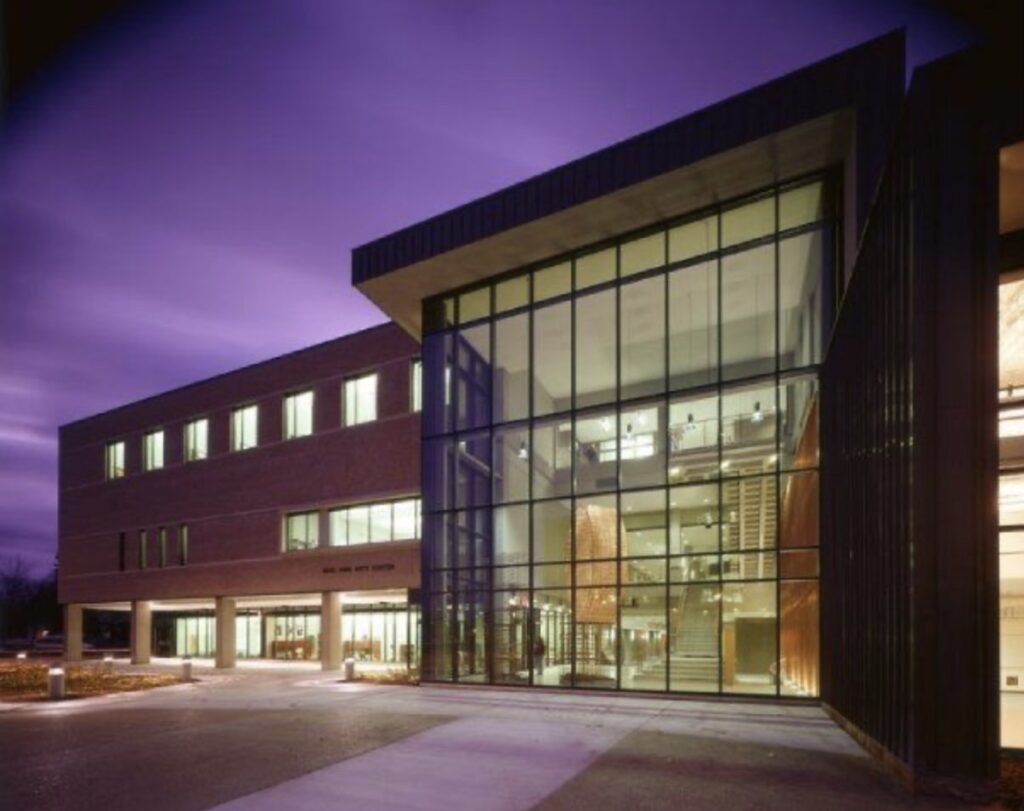
Under the ninth president (and later chancellor) of Wisconsin State University-Stevens Point, Lee Sherman Dreyfuss, came the continuation of construction of a variety of different buildings but most importantly the Noel Fine Arts Center. The university experienced a rapid growth specifically during the 60’s which was expected to continue growing, but unfortunately during Dreyfus’ first fall term, the numbers declined severely. The Noel Fine Arts Center was opened in 1970, which would house the fine arts majors.
Funding and Jazz Influence
The guest artist programs, however, would be nothing without the funding from the organizations that provide them with grants. Although the arts can generate income of their own, the reason that sets them apart from other institutions such as health services, is that the arts primarily rely on private contributions .There was an extreme growth in the 1980’s and the spending on the arts by funders increased by 37%. Specifically in 1977 the program received a grant from the National Endowment for the Arts and was able to bring a core figurehead of jazz dance to the university, named Luigi.
This can be associated with the need for growth in the arts during those times. Jazz dance became a significant during the 70’s because of its introduction to pop culture through television. The release of Cabaret (1972) and Saturday Night Fever (1977) contributed to the integration of jazz to the public. There was now a crave for art, as times were changing.
The NEA
The National Endowment for the Arts was established in 1965 and is regarded as one of the largest foundations to support both the arts and education within the arts. The goal of the foundation is to expand opportunities to engage with the arts and provide grants to a variety of different organizations. They also offer research grants both to further the understanding of the impact of the arts, and the social and behavioral sciences.
The Legacy and Impact
The Guest Artist program was originally created to foster opportunities for students to engage with the arts, but it turned into so much more. The continuation of the support of the arts was supported by the Sentry Insurance Invitation to the Arts Series, which shifted its focus towards interaction and education. There is a great need to continue the support for the arts especially with the ever changing world we live in. Although changes have been made between then and now, the legacy of the program lives on and fosters opportunities for the students of today and the future.
Sources
Primary
Paul, Justus F. The World Is Ours: A History of the University of Wisconsin-Stevens Point, 1894-1994. Stevens Point: University of Wisconsin-Stevens Point Foundation Press, Inc., 1994
Villee, Constance Review of Luigi: Protocol, Temperment, Ego, and Love. The Pointer, October 6, 1977
Secondary
Renz, Loren. 1994. “The Role of Foundations in Funding the Arts.” The Journal of Arts Management, Law, and Society 24 (1): 57–66.https://doi.org/10.1080/10632921.1994.9941757.
Hodsoll, Frank. “Supporting the Arts in the Eighties: The View from the National Endowment for the Arts.” Annals of the American Academy of Political and Social Science, January. https://doi.org/10.1177/0002716284471001009.
Leave a Reply