For many students, including myself, the past two semesters on campus have been a tangle of anxiety. The world has seen a shift: emerging turmoil, economic instability, a growing sense that the futures we were promised are falling further and further out of reach, and the list goes on. Anyone who watches the news could tell you we’re on shaky ground, especially with tensions hitting their boiling point in Iran.
There seems to be simultaneous pressure to know everything that’s happening in the world at once, and to sit down, shut up, and mind our business when it comes to commenting on it.
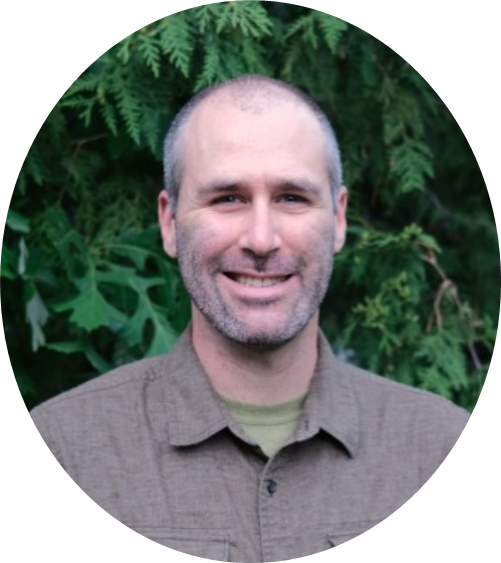
“The world kinda changed right about then. A lot of people were just trying to figure out what was going on,” said Justin Gleicher, whom I had the pleasure of interviewing on April 30th, 2026, right here on campus.
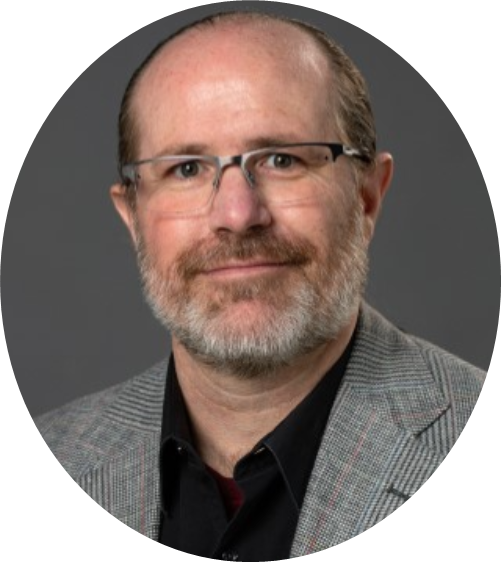
Just three days earlier, on April 27th, I also got to speak with Dr. Ryan T. O’Leary, both an alum of UW-Stevens Point and a professor at our Marshfield branch campus. He expressed similar thoughts as to the goings-on of campus and the general state of a student body trying to balance world conflict with personal studies and social lives.
Both of them were former editors of CounterPoint, a student newspaper that ran from 2001 until 2010. Its full title was CounterPoint: A Forum for Voices of Peace & Justice, Progressive Action & Thought. O’Leary was one of the core members who founded the paper. Gleicher would join a few months later, first as a writer, then as a layout artist, and finally as an editor following the graduation of most of the original staff.
… But wait. Obviously, Gleicher and O’Leary weren’t talking about the same campus as I am. Our experiences are twenty-some years apart. Why, then, did I hear so much of my own story as they shared theirs?
… 🕊 …
To better understand the paper, I asked a lot about the thought behind it. The 2000s run of CounterPoint traced its inspiration back much further, to the Vietnam-era Counterpoint (’68-70). Its roots were as a protest paper, full of pro-sex, pro-drug, and anti-war sentiments from students in Stevens Point. O’Leary and the rest of the founding circle picked up the torch again in the wake of 9/11 (with much less of a focus on sex, drugs, and rock and roll), with the earliest issue releasing in October of 2001.
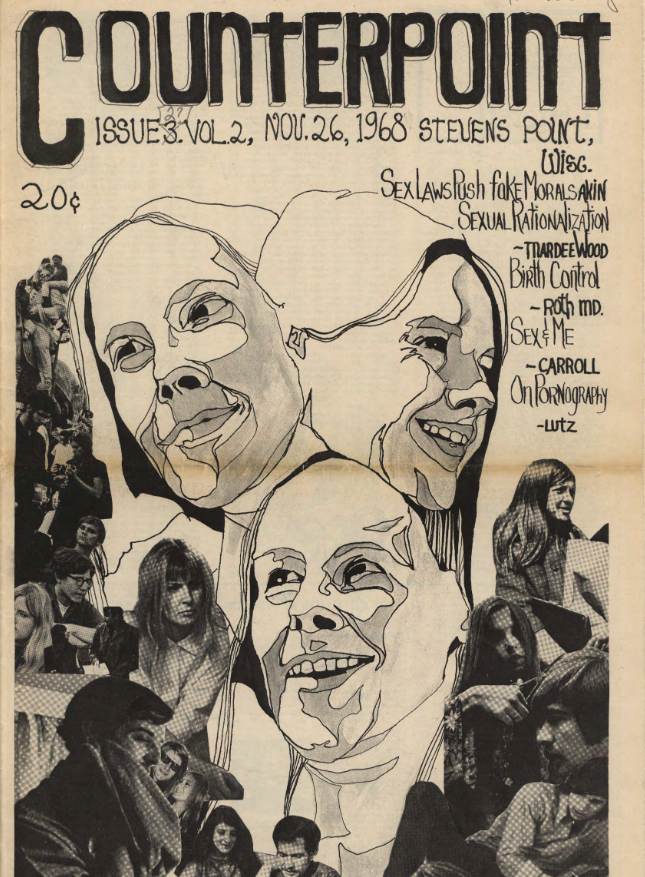
“I looked through the Archive, as I’m sure you did, and found [Counterpoint]. It was awesome! There was something we could link to,” O’Leary explained. “So, we revived it in a more twenty-first-century way.”
As O’Leary told me about the campus he knew, I couldn’t help but feel nostalgic—or maybe envious would be the better word. He described a great feeling of collaboration between organizations on campus. Although he admitted it sounded “stereotypical,” he said that without wide-spread cellphones and social media usage, things passed person-to-person more than screen-to-screen.
In the basement club lounge of the DUC, the CounterPoint team could simply cross the hall to collaborate with the Women’s Resource Center when they wanted to write about issues facing women. Each edition of the CounterPoint contained some variation of a “Calendar of Progressive Ideas,” broadcasting events and general meetings for groups like the Environmental Council, Progressive Action Organization (which still exists today), Amnesty International, and more. Big bold letters urged students to CONTACT CONGRESS, paired with the names, numbers, and offices of Wisconsin legislators.
Gleicher, too, had plenty to say about the climate on campus: UWSP was, at its core, an activist’s campus. He and I both have an interest in environmental ethics, and he pointed out that back in the 2000s, UWSP was truly at the forefront of conversation when it came to the value of nature and the meaning of sustainability. In terms of the anti-war movement, October 2001 issues of The Pointer and CounterPoint both reported that UWSP students were setting up peace camps at the campus sundial and in the now-defunct ShopKo parking lot downtown, staying overnight in tents and, at times, being pelted with raw eggs by drunk passers-by who wanted them to go home and stop protesting. There was a lot happening. Still, something was missing.
“We had two sort of major issues. One was that the student government didn’t really have [social issues] as a focus, didn’t really…recognize the things that were going on that we thought were important to have student government at least acknowledge,” Gleicher told me. “The other side of it was the student newspaper—we did not feel any representation…the perspective of students—of hey, we are, you know, anti-war, pro-worker’s rights, we’re pro-environmentalism.”
O’Leary, meanwhile, warned of the dangers of mainstream media even then, pointing to Herman and Chomsky’s 1988 Manufacturing Consent: the Political Economy of the Mass Media. In that book, they describe a system by which the news manipulates information to control public perception and ultimately uplift the dominant ideology.
“You could see the New York Times and, you know, the big papers manufacturing consent. They were doing it in real time, and we were frustrated by that. I wouldn’t say that the Pointer was doing that. It was more that the Pointer was just not really concerned—which is fine… it’s a campus newspaper talking about campus stuff. But we decided that there needed to be some sort of a clearing house where people could get some of the news that they weren’t getting from the mainstream press and hear some of these opinions and start publicizing them, and say, like— war is bad!”
In the interview, I gasped and held my head in shock. WHAT? We shared a chuckle at that.
Largely, the paper was corollary to the work that students like O’Leary and Gleicher were already doing. It was all about getting information out for people to see. It’s fitting that the first quote featured in CounterPoint was this: be the change you wish to see in the world.
… 🕊 …
What was the CounterPoint talking about, then? Not every article was written by students, but many of them were. Sometimes, the paper republished press releases from groups like Amnesty International or the National Wildlife Federation just to boost their visibility to students.
“Apathy is our only enemy in today’s world,” O’Leary wrote in CounterPoint, Volume 2, Issue 8.

Featured in that February 2003 issue were reports on the Texas death penalty, attacks on the Clean Water Act, the fight again water-polluting government projects, and a think-piece on the morality of transportation, and… the kind of car Jesus Christ would drive to school—spoiler alert, it’s fuel-efficient.
In other issues, they covered oil, protests, gay rights, elections, climate change, environmental policy, war, contraceptives, reproductive rights, and the economy. Concerns about Afghanistan morphed into concerns about Iraq.
Gleicher and I had a bittersweet laugh at the fact that even when he was at UWSP in the early 2000s, there were anti-war bumper stickers that featured “NO WAR IN IRA-” and then a dial stuck halfway between “Q” and “N.” Iraq and Iran. O’Leary had already expressed to me that it was pretty obvious that once war started in the Middle East, we’d never be totally free of it.
As I spoke with the two CounterPoint team members, I was struck over and over again with a sinking sense of familiarity. I was, and still am, torn between a horrified “we’ve been here before,” and a hopeful “we’ve been here before!”
I feel oddly reassured that there have always been students advocating for the same issues we face today. Even though it’s a bit harrowing that times haven’t changed all that much, there’s still progress to be seen. We can see some of it right here on campus.
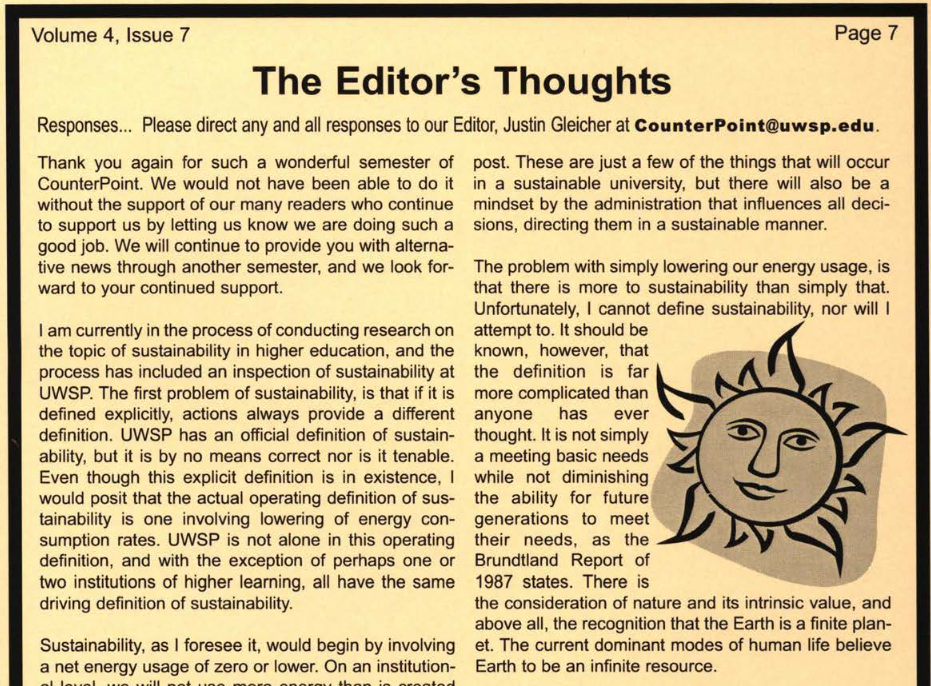
In the editorial published in Volume 4, Issue 7 of CounterPoint, Gleicher urged UWSP to reconsider what it meant to be sustainable. Some of his ideas included solar collectors to “provide all hot water needs, backed up by steam created through burning biomass” and dorm buildings that captured “as much waste for reuse as possible,” namely food scraps for compost.
“This will likely not be easy; nor are we the only university with foreseeable trouble overcoming this obstacle,” he wrote. And yet… here we are.
Hot water in the dorms comes from solar panels and is backed up by steam we produce here on campus. We compost across the residence halls, dining, and university centers and manage it ourselves for use in landscaping. We move closer to meeting energy efficiency guidelines every year. The student-led Green Fund drives us ever forward. It’s hard to say if Gleicher was simply ahead of his time or if somebody on the Sustainability Committee took notes, but there have been great strides to meeting his demands.
Change is possible when the support of students is behind it. The student voice is, and always has been, a central part of UWSP.
… 🕊 …
At this point, you’re probably sitting there wondering why you should care. It isn’t my place to urge you toward any stances shared in CounterPoint (though I hope you can feel my gentle nudging as you read this), but I would like to leave you with some parting thoughts.
I’ve had adults throughout my life tell me that I don’t know enough to comment on societal issues—that I just don’t understand—and in nearly the same breath remind me that it’s my generation that will bear the weight of fixing everything that’s wrong with the world. While I was writing this, many of my peers shared similar experiences with me.
Sitting in my final Advanced Environmental Ethics class of the semester this past week, I became part of an interesting discussion about the ever-shifting goal posts of what it means to be educated. Somewhere along the line, society got stuck on the idea that there is a line you can’t cross when you’re a student; at some point, you become too empathetic, too invested, and somehow those are traits that makes you weak-minded instead of intelligent.
University campuses have long been the birthplace of progressive movements, evidenced by more than just alternative school newspapers. Why, now, is it suddenly our place to remain quiet or neutral about the issues that shape the world we live in?
I asked Dr. O’Leary for his final thoughts on the matter.
“It was really my studies that got me into activism, and then, you know, the activism that started to guide my studies. I’d like to say thank you to everyone who helped me along that journey. And for the current students, this is something that I try to stress all the time: this stuff you’re learning is not just abstract classroom work. It really does—it should—have a connection outside your classroom.
… If your study of philosophy, or history, or anything else doesn’t translate into changing your life in one way or another, then it’s pointless. People on campus, this is an opportunity that a lot of people don’t get—to just wrestle with big ideas and think about your place in the world.”
In the rush of news and nerves that is our current climate, maybe it’s time to take a step back and wrestle. Maybe it’s time to bring back the spirit of the CounterPoint. So, I pass the question on to you: what does it mean to be a Voice on campus?
Please check out all of the issues of the CounterPoint through the UWSP Digital Collections! The full interviews with Justin Gleicher and Dr. Ryan O’Leary will be available through the Archives sometime in summer 2026, or immediately through email — reach out to me at dalle865@uwsp.edu. Thank you for reading!
Leave a Reply