
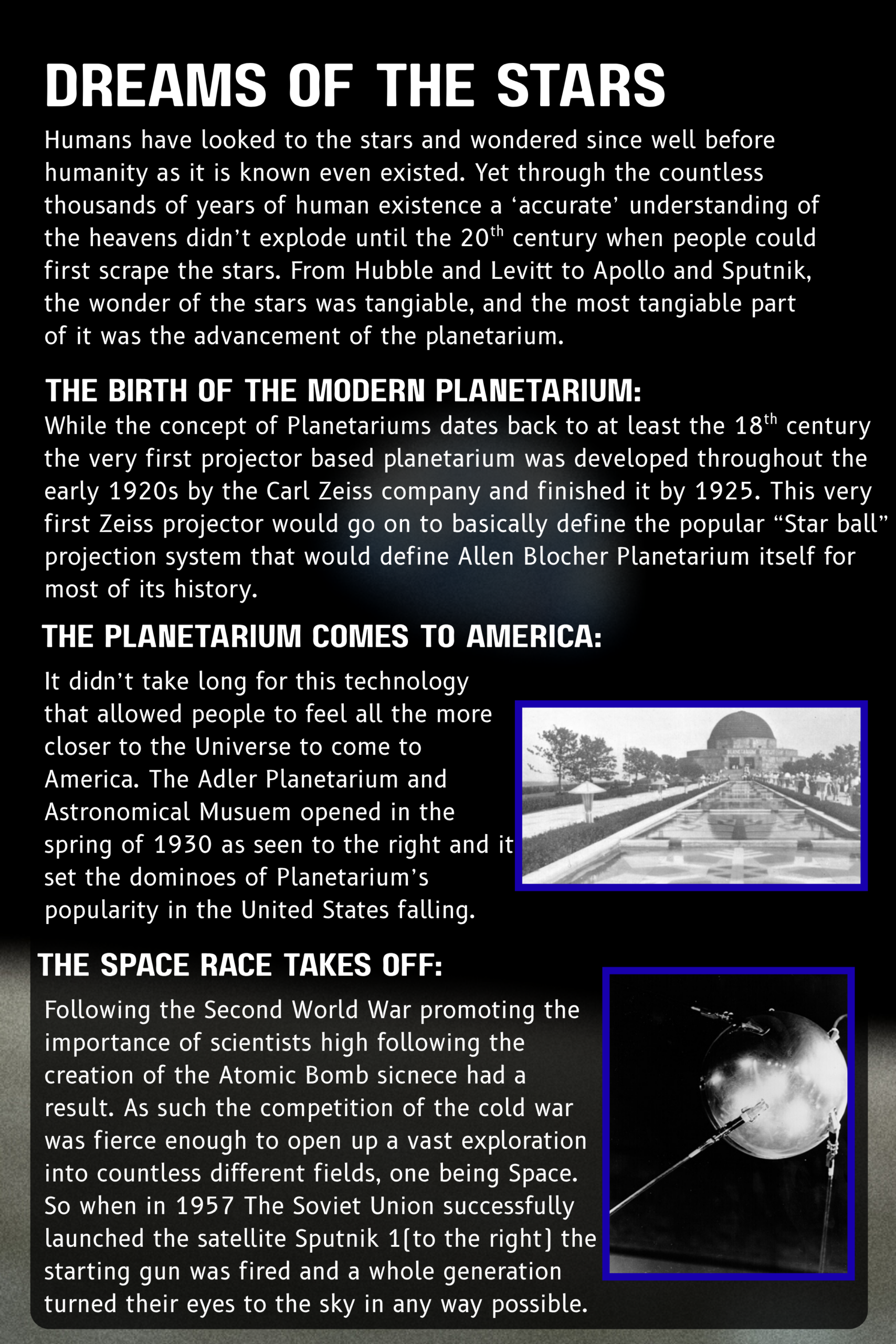
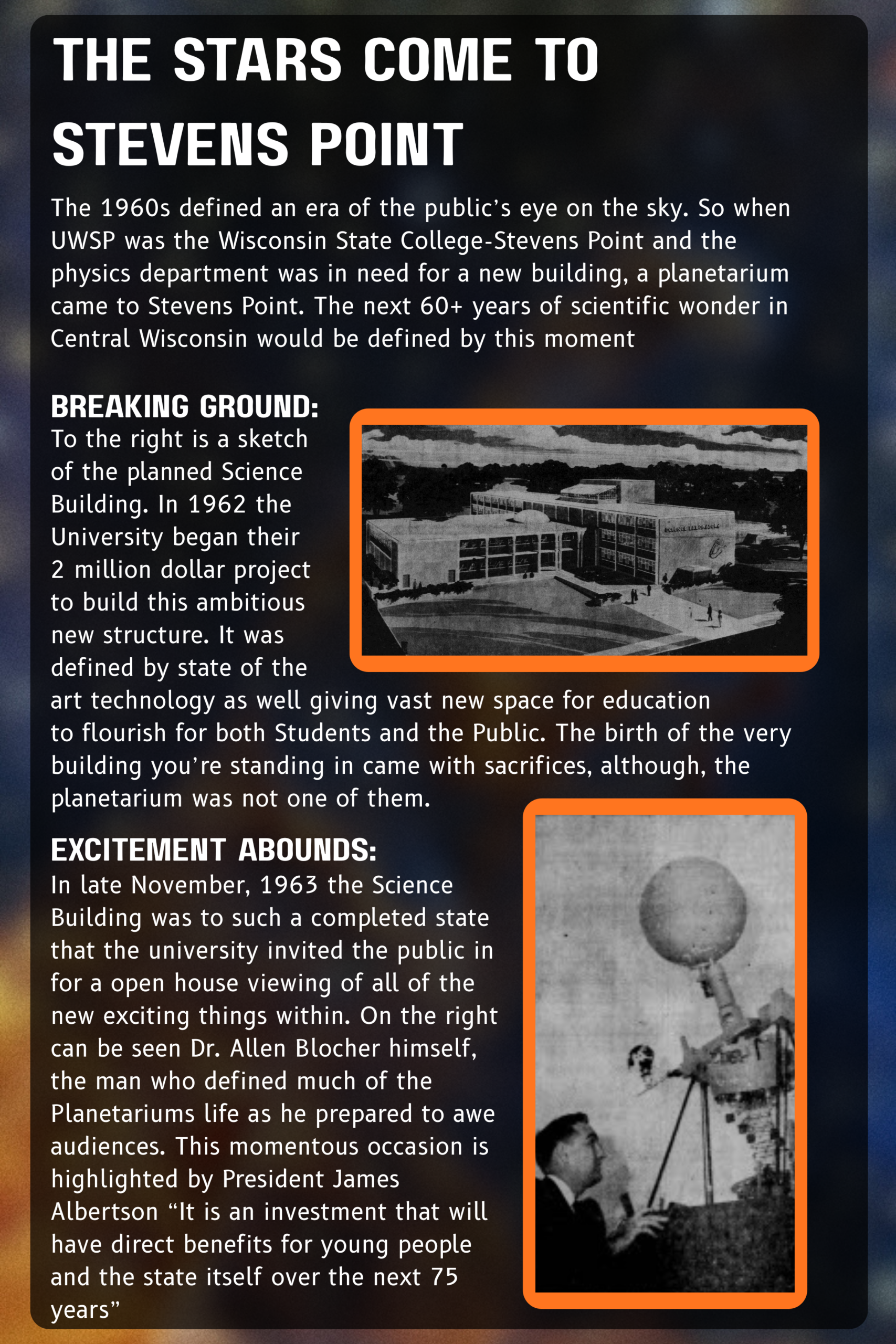
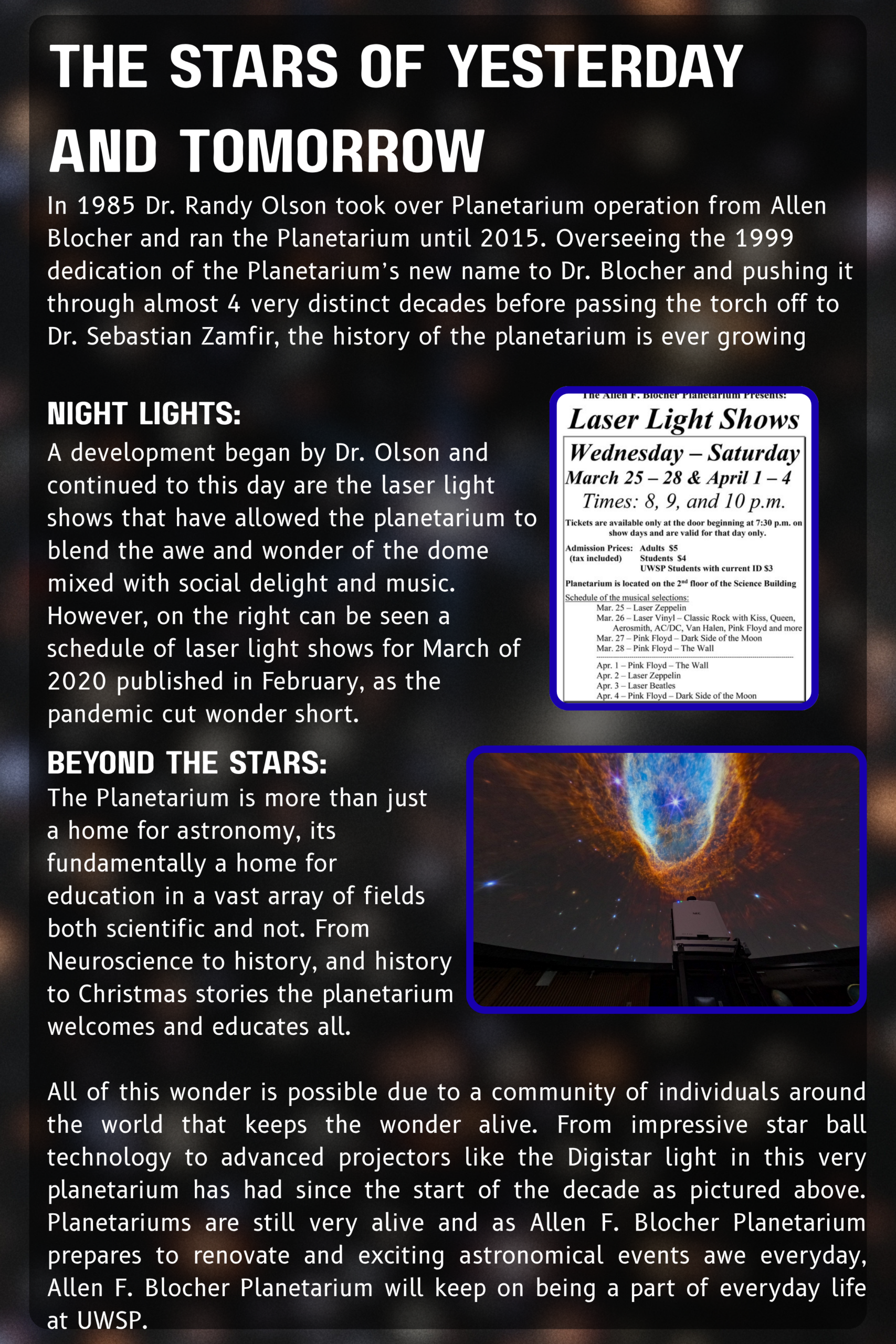
The modern projection based planetarium came into existence in 1920s Germany and rapidly expanded outwards across the world. So that at the dawn of the Space Age in the 1960s, following the expansion of STEM education as a result of the Second World War and the advent of the Cold War, UWSP pursued a new Science Building to meet demands. One of the many features of this new building that was meant to dazzle and educate was the state of the art Planetarium system. However, this new feature on campus would go on to be so much more over its still expanding life span.
While the history of the Allen F. Blocher Planetarium is 63 years in the making as of Spring 2026, the exhibit Scraping The Stars is meant to see many different angles. With modern numbers post the COVID-19 Pandemic sitting at approximately 5,200 visitors1 a year, there are countless personal stories. As such this project seeks to introduce the history of the educational impacts of the planetarium, as well as how it reflects the lives of those who ran and visited it, as countless different individuals found wonder by scrapping the stars.
The Exhibit Posters:
Miss The In-Person Exhibit: No Worries!
Just because you couldn’t make it while the exhibit was still up doesn’t mean you can’t experience everything just the same!
Zeiss Company “Centennial of The Planetarium” Show:
Companionship In Excitement:
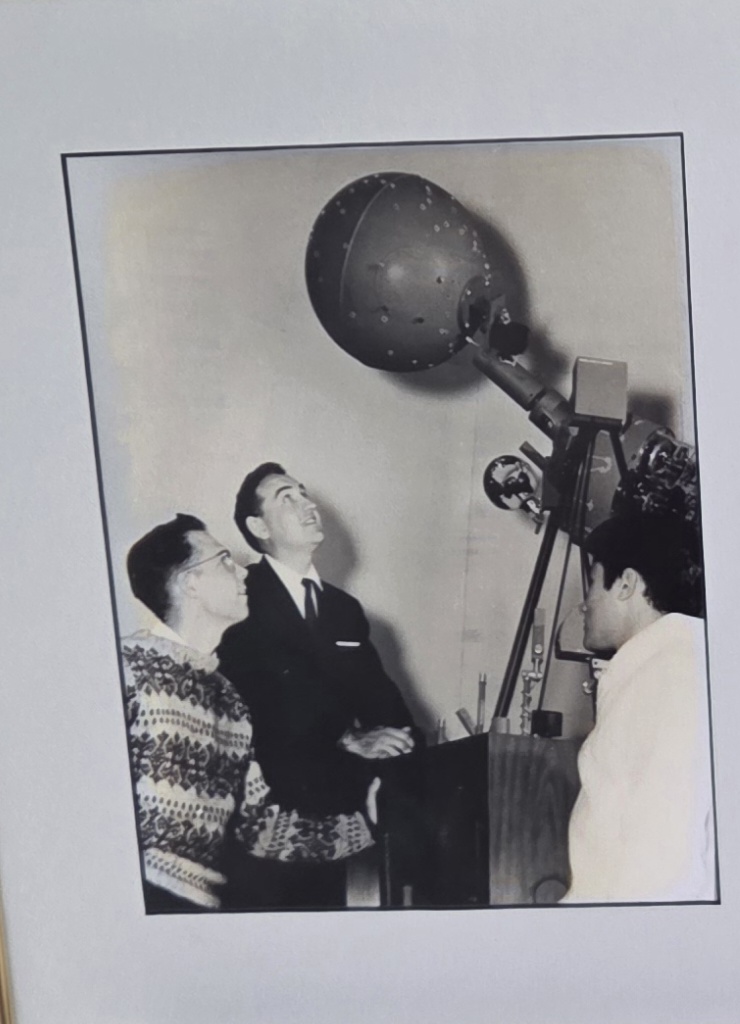
While individuals like Allen Blocher shaped and molded the course of the Planetarium over three decades, their main goal wasn’t to be remembered. From professors to their student lecturers they sought and still seek to bring their passion of telling stories and educating about the stars and their intersection with the past and future of humanity. So in 1963 as the day of a public opening of the new planetarium drew near, Allen Blocher and two students gaze to the Spitz Projector in anticipation of the awe that it will bring .
The Star Ball:
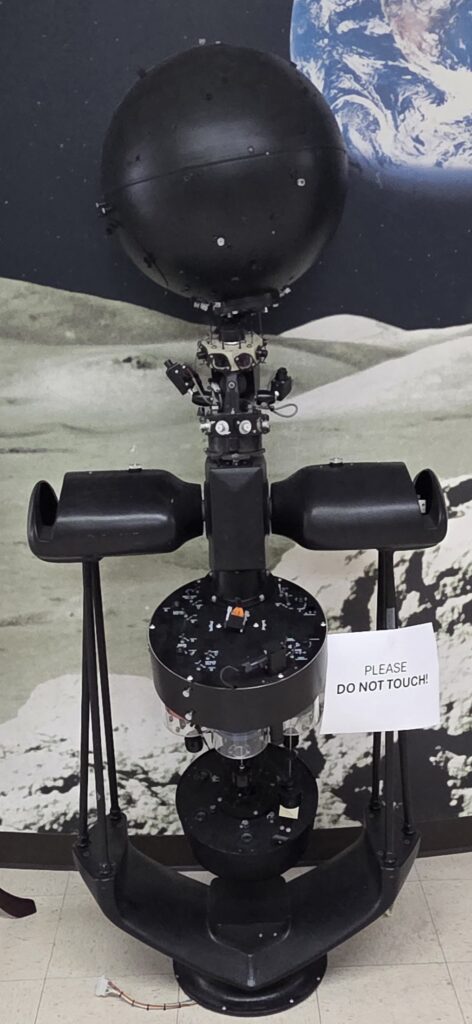
This impressive Spitz Inc. Star Ball was the second projector at the Allen F. Blocher Planetarium. These traditional projectors operated via the spherical projector mounted on top which mimicked the celestial sphere of visible stars from Earth. They achieved this through thousands of holes within the sphere itself that light would shine through to project the stars onto the planetarium’s dome. Beyond this they had the ability to match the location of the planetarium to system as well as the locations of the moving planet. While this system was replaced in 2020 for a Digistar digital system, the star ball remains an intriguing artifact of the past of display.
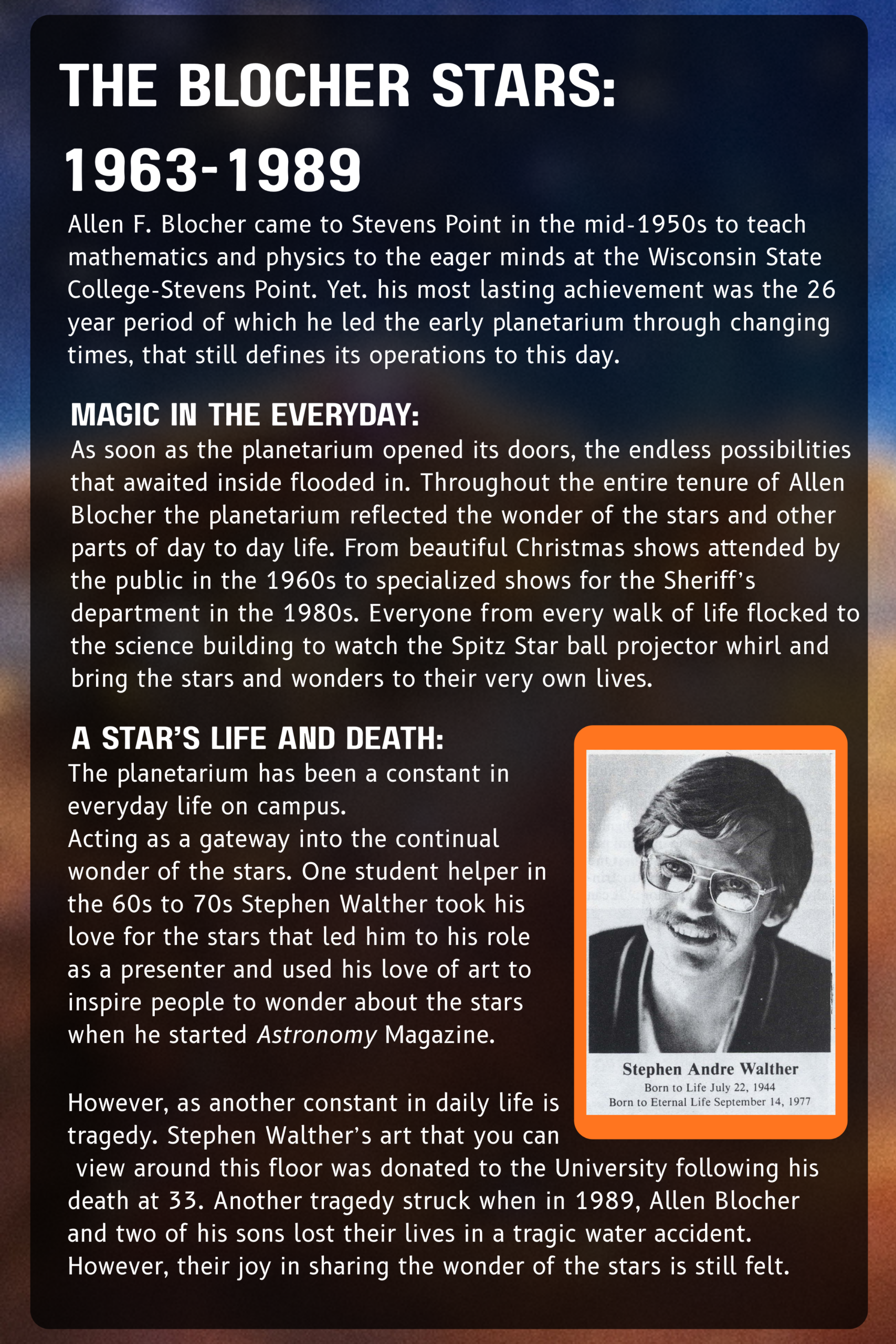
The Art of Stephen Walther:
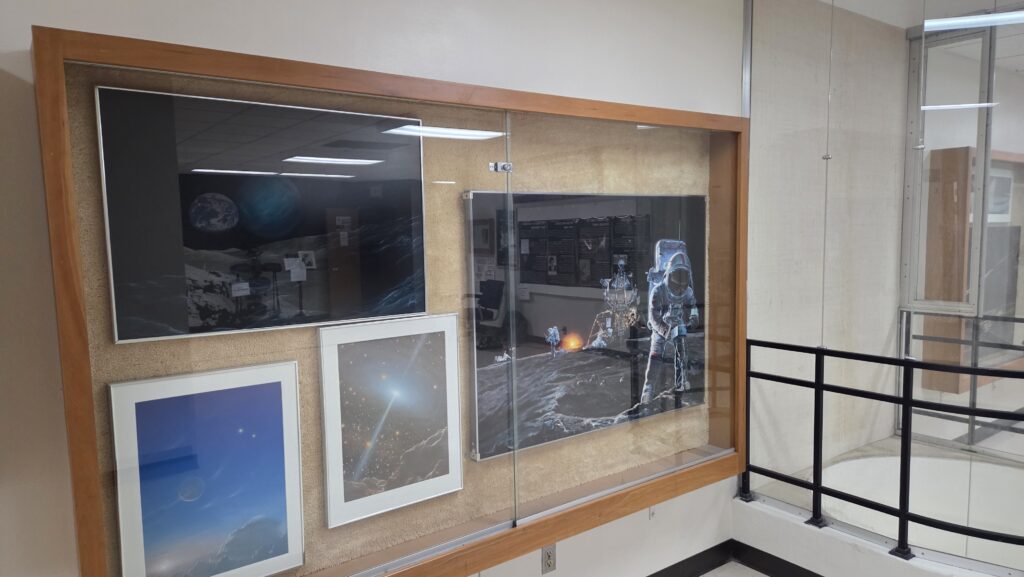
Here is a small sample of the beautiful artwork of Stephen Walther. His ability to capture the wonder of the universe in a way few others before him could paved the way to the success of his magazine. His life was changed here at UWSP and he went on to inspire others based on what he experienced under Blocher.
The Science of Why Planetariums Work as Educational Devices:
While the education presented by Allen F. Blocher in the latter half of the Twentieth Century or by Dr. Zamfir in the Twenty-first may seem solid, what is the actual merit of planetarium education? Well, in 2014 Cumhur Türk and Hüseyin Kalkan performed a study for The Journal of Science Education and Technology to determine what makes planetarium education unique. Their findings were that due to the immersive nature of the planetarium as well as the ability to ask hands on questions allowed students to grasp complex and abstract scientific concepts (Türk 11). 2
Acknowledgements and Further Engagement:
This exhibit wouldn’t be possible without the gracious help of the Allen F. Blocher Planetarium and Dr. Sebastian Zamfir.
As well as Dr. Cory Haala coordinator of the Museum Studies Minor.
And last but not least Steven Kolins, a student lecturer during the 1980s who collected and annotated ~50 years of newspapers surrounding the planetarium.
Interested In Astronomy/Planetarium Methods and History? Check Out These Sites:
Interested in catching a show, keep up to date here: https://www.uwsp.edu/smcpa/school-of-mathematics-computing-physics-and-astronomy/blocher-planetarium/
Want to do a little stargazing while on campus, check here: https://www3.uwsp.edu/physastr/plan_obs/Pages/observatory.aspx
Want to learn more about the 100 years of ZEISS Planetariums, look here: https://www.zeiss.com/corporate/en/c/global-campaigns/100-years-of-planetariums.html
Interested in how various cultural groups have come together to educate about unique views on the stars, look here: https://oneskyproject.org/
Wish to keep up to date on Solar System Phenomena? Check here: https://www.spaceweather.com/
Interested in the Association that is influencing change in Planetariums? Check out: https://glpa.org/
Bibliography of Research:
Stokley, James. “Planetarium Operation.” The Scientific Monthly 45, no. 4 (1937): 307–16. http://www.jstor.org/stable/16412.
“Allen F. Blocher is New Faculty Member Here”, The Pointer, October 14, 1958, page 4 https://cdm17556.contentdm.oclc.org/digital/collection/pointer/id/7785/rec/6
“Science Building bids opened in Madison”, Stevens Point Journal, June 29, 1962, Page 1
“Break ground for CSC’s new Science Building”, Stevens Point Journal, July 18, 1962, Page 1
“WSC to show new Science Building”, Stevens Point Journal, November 29, Page 14
“”Under stars” program at planetarium”, Stevens Point Journal, December 17, 1963, Page 8
“Planetarium series to begin Wednesday”, Stevens Point Journal, February 10, 1964, Page 12
“”A trip to the moon” series is slated at WSC planetarium”, Stevens Point Journal, April 17, 1964, Page 8
“Warren to speak here at sheriffs meeting”, Stevens Point Journal, January 14, 1970, Page 6
“Stephen A. Walther Obituary”, Stevens Point Journal, September 15, 1977, Page 2
“Tragedy Befalls Blocher Family”, Winter Pointer Alumnus, 1990, page 8
Paul, Justus F. 1994. The World is Ours: A History of the University of Wisconsin-Stevens Point, 1894-1994. Stevens Point, Wisconsin: University of Wisconsin-Stevens Point Foundation Press.
Member of the Chancellor’s office, “Blocher Planetarium Dedication”, Stevens Point, Wi, October 16, 1999, Series 466 – Office of the Chancellor, Speeches and Events File, Box 3, University Archives, University of Wisconsin-Stevens Point
Türk, Cumhur, and Hüseyin Kalkan. “The Effect of Planetariums on Teaching Specific Astronomy Concepts.” Journal of Science Education and Technology 24, no. 1 (2015): 1–15. http://www.jstor.org/stable/43867446.
University of Wisconsin Stevens Point College of Letters and Sciences, “27th annual Undergraduate Research Symposium”, 2026
University of Wisconsin Stevens Point College of Letters and Sciences, “Randy Olson Biography”, Department of Physics and Astronomy, https://www3.uwsp.edu/physastr/Pages/FacultyStaff/Randy-Olson.aspx
Leave a Reply