
Shot in the Street
On the evening of June 19th, 1886, everything was the norm for a Saturday evening as citizens of Stevens Point bustle around Main Street. The bustle and chatter of the residents was soon broken by the crack of three shots in the street, as Amos E. Morse, a cashier of the First National Bank of Stevens Point, fell dead in his buggy that he rode with his wife. According to initial witnesses, not a word was spoken between the deceased and his murderer during the shooting, with one Adam Kuhl who identified the shooter as Willis W. Haseltine, a local attorney, in a light-colored suit and hat. Haseltine would later surrender himself that day to the authorities after the murder, and would be released on a bond of $10,000, or $350,000 today when adjusted for inflation. This murder and proceeding trial soon became discussed far beyond Steven’s Point and would become the hallmark case that represented the crime wave that hit Stevens Point in the 1880s-1890s. Steven’s Point and Portage County newspapers immediately started reporting the case, and the local residents would become heavily invested in the event. There would be a pause in reporting on the case until early October as the preparations for Haseltine’s Trial began, where it would again capture local public attention.

The Trial
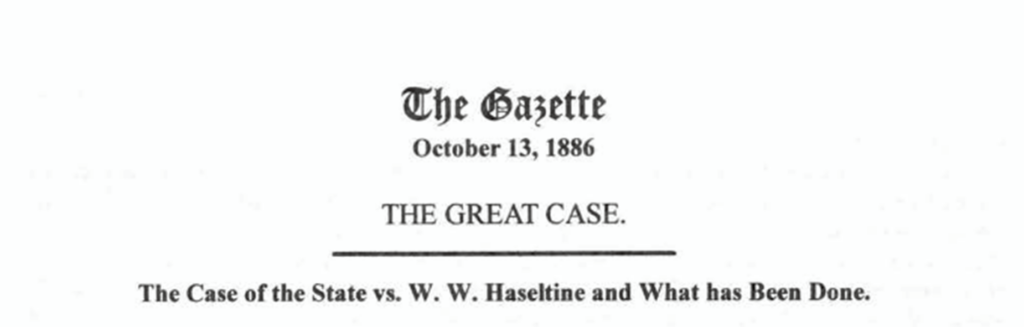
The trial would soon become the headlines of the Steven’s Point Journal, the Daily Northwestern published in Oshkosh, and The Gazette located in Stevens Point, as the jury selection began for the trial on October 12th. On the first day, 35 jurors were examined, of which 2 were deemed impartial enough for the trial, with a special selection of 75 jurors ordered for the next day (20). This would be done by the Sheriff and his deputies that night, who traveled as far south as Almond and as far east as Amherst collecting jurors for the trial. Over 60 jurors would be drawn and challenged from this 75-juror pool, before an acceptable and unbiased jury was obtained for both prosecution and defense, and would be sworn in on the 13th, before being adjourned. The case would be opened by the remarks of the defense, who lays out the reason for the murder. Morse and Haseltine were fast friends since both of them moved to Steven’s Point, with Morse being Haseltine’s banker, while Haseltine was Morse’s lawyer. Haseltine knew nothing of the affair between Morse and his wife, up until he learned about the affair from an anonymous letter on June 18th. He was identified by witnesses as crying and inconsolable as he resided in a building overlooking Main-street that afternoon before he spotted Morse coming down the street at that moment, when he remarked to the witness “D-mn him, there he comes now” and left the building in a state of great excitement, before committing the murder. Finally, with the stated witness testimonies, stated that Haseltine was temporarily insane at the time, and was not in control of his own actions.
Temporary Insanity
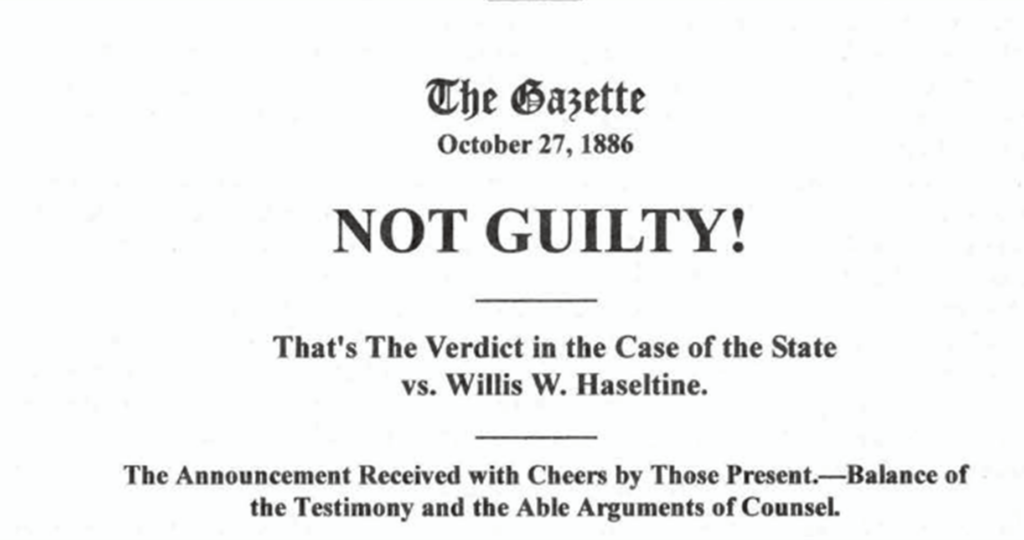
Temporary insanity is a unique defense used in cases where the defendant states that at the time of the crime, they had no control of their actions and were insane, but after the crime returned to full mental capacity. This case is the second documented case of its use in Wisconsin history, and is defined under Wisconsin Statute 971.15.1 as “a person is not responsible for criminal conduct if at the time of such conduct as a result of mental disease or defect the person lacked substantial capacity either to appreciate the wrongfulness of his or her conduct or conform his or her conduct to the requirements of law.”. At the time of the late 1800s when this murder took place, there was a growing use of the temporary insanity plea to follow the “unwritten law” or a “code of honor” when it came to adultery or any scenario deemed dishonorable. This means that the defense went from a defense where the jury ignored the law/evidence to acquit, to as a justification of the act, meaning the jury said that his actions were justified under the circumstances. This thinking would highlight how the verdict was reached after testimonies from witnesses describing Morse’s and Mrs. Haseltine affair, along with three doctors (only one of them being specialized in cases of insanity) describing Haseltine as beyond self control, when they announced on October 22nd, 1886 that they found Willis W. Haseltine not guilty for reason of insanity, and find him of sound mind at the trial, ending the strange case that sits now as a highlight of the 1880s crime wave in Steven’s Point.
Sources
Covey, Russell D. “Temporary Insanity: The Strange Life and Times of the Perfect Defense.” Reading Room, January 1, 2011. https://readingroom.law.gsu.edu/faculty_pub/1368/.
Eugene M. Fahey, Laura Groschadl & Brianna Weaver, “The Angels that Surrounded My Cradle”: The History, Evolution, and Application of the Insanity Defense, 68 Buff. L. Rev. 805 (2020). Available at: https://digitalcommons.law.buffalo.edu/buffalolawreview/vol68/iss3/2
Peplinski, Dianne. “Newspaper Accounts of: The Murder of Amos E. Morse & The Trial of W. W. Haseltine.” Collection. In Homicides (Portage County), 5–82. Stevens Point, Wisconsin: University Archives, University of Wisconsin-Stevens Point, 2007. https://cdm17556.contentdm.oclc.org/digital/collection/verticalfiles/id/10646/rec/9.
Point, University of Wisconsin–Stevens. Portage County Shadows: Notorious People, Places and Events from Portage County’s Past, 1990
Rosholt, Malcom L. Our County, Our Story: Portage County. Worzalla Publishing Company, 1959.
Leave a Reply