

Access to affordable and reliable childcare is not just a convenience but a fundamental aspect of supporting women’s participation in the workforce. Yet, when looking at the United States as a whole, it is clear that women face significant barriers when it comes to accessing childcare services. Roughly 51% of all United States residents live in a childcare desert. A childcare desert is defined as “areas with an insufficient supply of licensed childcare.” This phenomenon strongly affects marginalized communities and occurs in urban, suburban, and rural communities. These deserts make it exceedingly challenging for women, particularly those in lower-income communities, to find care for their children while they work or pursue an education. In Wisconsin, over half of the families and 70% of families living in rural communities live in a childcare desert. This is an issue that CBS News reported on in Wisconsin, stating that “there’s only one spot available at childcare centers for every three kids.” The source went on to note how, in the Fox Cities region of Outgami County, there are roughly 200,000 residents and more than 1,200 children on a waitlist for childcare. Given the high demand, many centers have stopped using waitlists entirely. A local mom, Kelsey Riedesel, noted how she called 12 daycare centers, all of which had waitlists of at least a year, and she eventually lost her job because of it.
With this in mind, only 69% of mothers of young children are active in the labor force. Not to mention that the Center for American Progress found that childcare deserts have a strong correlation with fewer mothers in the workforce. Limited access to childcare can act as a barrier to employment or educational opportunities for women. Without reliable childcare, women may be forced to sacrifice job opportunities or curtail their career ambitions. Moreover, the onus of caregiving falls disproportionately on women. In the absence of accessible childcare, women are more likely to take on the primary caregiving role. The University of Wisconsin–Madison, in their study Are the Kids Alright? Women, Work, & Childcare, asserts that the burden of childcare appears to be driving women out of the labor force. When looking at the role of childcare costs in employment decisions, 34% of men said that “the cost of childcare was a consideration for their own careers,” compared to 51% of women. Similarly, a mere 20% of men said that they “cut back on hours or quit a job because of the cost of childcare,” compared to 42% of women.
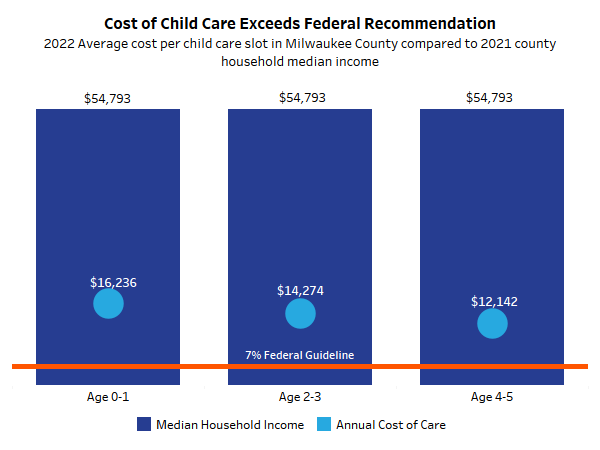
When looking at the cost of childcare and the causes and consequences of youth disconnection, the article Disconnected Young Adults: Increasing Engagement and Opportunity, explains that the lack of access to childcare is also a cause of disconnection for young parents. The article illustrates how it is exceedingly difficult for young parents to work and attend school, especially when considering the cost of childcare. According to a 2022 report from the Wisconsin Policy Forum, “the average cost of a 4-year-old in Milwaukee County was $12,142, while the cost of an infant was $16,236.” To compare, these costs are significantly higher than the cost of tuition at any university in Wisconsin and equate to roughly 22.2% (four year-olds) or 29.6% (infants) of the 2021 annual median household income in Milwaukee County. Keep in mind, federal guidelines recommend that no more than 7% of a household’s income should go toward childcare. One of the primary reasons for this stark price tag is simply because of the little pay childcare workers receive, which causes them to switch careers. Since 2010, the number of childcare workers in Wisconsin has declined by 26%. Addressing the issue of childcare deserts and improving women’s accessibility to childcare is not only a matter of gender equality but also economic and social prosperity. Investing in affordable, high-quality childcare would not only benefit women and children but also the community as a whole. Supporting women’s workforce participation and boosting children’s development would foster economic growth by enabling both parents to pursue employment and educational opportunities.
Thank you for reading my blog! If you are interested in learning more about how UW-Stevens Point has helped student, faculty, and community mothers pursue their education while offering quality and affordable health care, then you should read my next post, Beyond the Books: UCLCC’s Legacy of Supporting Parents
Sources
Conroy, Tessa, and Kristin Runge. “WIndicators Volume 3, Number 5: Are the Kids Alright? Women, Work, & Childcare.” Community Economic Development, University of Wisconsin – Madison, 2020, economicdevelopment.extension.wisc.edu/articles/ windicators-volume-3-number-5-are-the-kids-alright-women-work-childcare/.
“Do You Live in a Child Care Desert?” Center for American Progress, Center for American Progress, childcaredeserts.org/2018/.
Loprest, Pamela, et al. “Disconnected Young Adults: Increasing Engagement and Opportunity.” RSF: The Russell Sage Foundation Journal of the Social Sciences, vol. 5, no. 5, 2019, pp. 221–43. JSTOR, https://doi.org/10.7758/rsf.2019.5.5.11. Accessed 7 May 2024.
Meisler, Hallie. “Please Stop Using the Phrase “Child Care Desert.”.” National Women’s Law Center, 3 Aug. 2023, nwlc.org/please-stop-using-the-phrase-child-care-desert/.
“Not Mere Child’s Play: Unpacking the Economics of Early Childhood Education and Care.” Wisconsin Policy Forum, Wisconsin Policy Forum, May 2023, wispolicyforum.org/research/not-mere-childs-play-unpacking-the-economics-of-early-childhood-education-and-care/.
Oliver, Meg. “Wisconsin Mothers Search for Solutions to Child Care Deserts.” CBS News – Breaking News, 24/7 Live Streaming News & Top Stories, CBS News, 6 June 2023, www.cbsnews.com/news/child-care-deserts-joyful-beginnings-academy-wisconsin/.
White, Sean. “New Study Shows Wisconsin Childcare Costing More Than Tuition at UW-Madison.” 20 Sept. 2023, www.wsaw.com/2023/09/20/new-study-shows-wisconsin-childcare-costing-more-than-tuition-uw-madison/.
Wisconsin Women’s Council. “The State of Childcare in Wisconsin.” Wisconsin Department of Children and Families, Wisconsin Department of Children and Families, 1 Mar. 2024, womenscouncil.wi.gov/Documents/The%20State%20of%20Child %20Care%20in%20Wisconsin_Wisconsin%20Womens%20Council_March%201%202024.pdf.
Leave a Reply