
Back in the days of old, German was the “High Standard” language in many areas; the Arts (musicals, operas, plays), Sciences (chemistry, physics, and most published works), and was one of the most widely spoken languages in Europe. When settlers came from Europe, especially in the late 1790s and throughout the 1800s, the German language came with them. Yet by the time the US was founded, English was chosen as the language of official business, despite popular movements to publish government documents in German as well. 1
By 1848, the majority of settlers in Wisconsin were German immigrants, having fled their homeland due to political repression and general instability. In the towns settled by Germans, their language varied wildly, with many differences separating their dialect from “Hoch Deutsch”, or standard German (in some cases, so much so that the Wisconsin schools (which were taught in German) struggled to teach due to lingual differences).2
So what happened?
To explore this question, we will explore the archives at the University of Wisconsin-Stevens Point, especially the Krembs Family Collection within the Nelis R. Kampenga Archives and Area Research Center.
The Krembs family was in the Stevens Point area from (roughly) the late 1800s, consisting of 8 members, headed by a widowed matriarch, Johanna (later Jeannette. She married a German chemist in Stevens Point named Moritz (who passed away around the 1910s). Also in the Krembs family were 6 adult offspring. The letters and notes written between these family members remain in the university’s archives to this day.
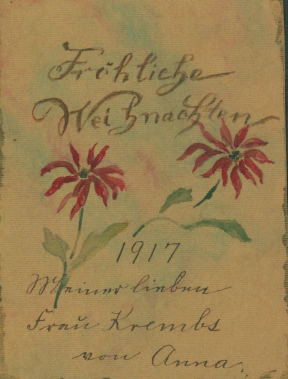
Her correspondence, in both German and English, detailed average life during the time, discussing family vacations (and the excitement of lake-going)3, Christmas cards 4, and even handwritten song lyrics on a funeral program for Kaiser Wilhelm I 5.
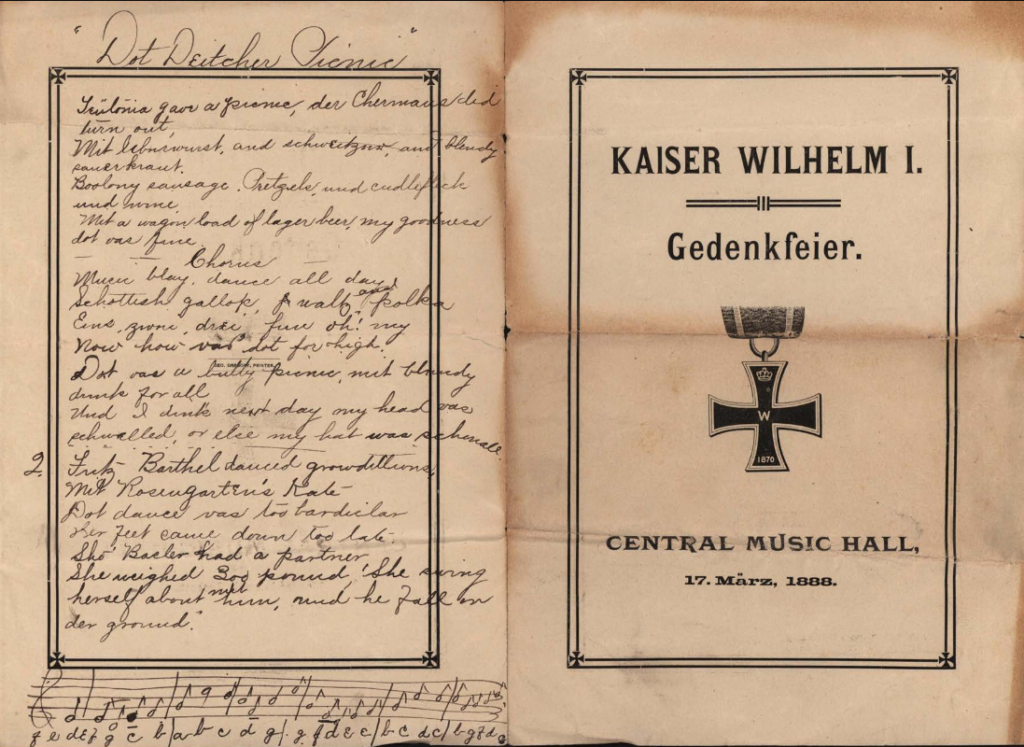
Top: Funeral Program for Wilhelm I from the Stevens Point area, with handwritten lyrics for Dot Deitcher Picnic, dated 17 March 1888
Bottom: “Happy Christmas” Christmas Card for “Frau” (Johanna) Krembs(from Anna), dated 1917
Reading these pieces in chronological order will result in a clear yet nuanced linguistic pattern, in which German dominates the interfamilial notes. On the other hand, the family’s English was reserved for business letters and non-familial matters. German is used in roughly half of the collection’s correspondence, but declines in prevalence and disappears almost entirely after 1917.
There are 2 possible explanations, both hinging around World War 1.
The first (and more likely answer) was due to the unpopularity and danger of being German during this period. Some common/wider examples of this could be Sauerkraut and Bratwurst, which became “Liberty Cabbage” and “Liberty Sausage”, in an effort to separate themselves from their German roots. In the case of the Krembs family, Johanna adopted a more “American” name, taking on the name of Jeannette.
The second explanation is (admittedly) outlandish, but it’s compelling and has to do with a tragedy (both personally and politically).
Leona Krembs, a daughter of Johanna and Moritz, married Erich Muenter in 1906, and they attempted to start a family. This would prove to be a fatal mistake, and Erich’s actions would culminate in national headlines. Erich was erratic and unpredictable. He murdered his pregnant wife with poison, not long after marriage, killing both her and the child.
Erich’s actions would result in a decade-long manhunt, where he took the alias of Frank Holt, obtained positions as a professor at Harvard and other Ivy League schools. But he wasn’t finished yet. After the start of World War 1, Erich would bomb the US Capitol Building, attempt to assassinate the son of JP Morgan (Jack Morgan), and plant bombs on ships laden with aid, bound for Great Britain.6 His spree would end in July of 1915, ending with Erich jumping out of his jail cell window to his death.
Despite American neutrality (up to 1917), perhaps the treasonous and nationally known actions of Johanna’s son-in-law became the final reason for the Krembs family to discontinue German.
Post War
Regardless of what may have caused the Krembs family to abandon their German roots, the general outlook in Wisconsin (and to a wider point, the US) was clear: the German language declined massively by 1920, and even further after World War 2.
Despite the decline of the language, residents of Wisconsin (in exceedingly high numbers) continued to identify as German or of German descent.
(I invite you to try this Juxtapose map showing the differences in German Heritage in Wisconsin between 1915 and 2015!)
Use this link if the insert doesn’t work:
Images in Juxtapose obtained from UW-Madison
Thanks for reading!
- German-American and American English Dialects. “German Dialects in Wisconsin.” Accessed March 31, 2026. https://language.mki.wisc.edu/essays/german-dialects-in-wisconsin/.
↩︎ - Multilingualism and Education in Wisconsin. “History: German — Multilingualism and Education in Wisconsin,” n.d. https://www.teachlangwisconsin.com/germanandpennsylvaniadutch. ↩︎
- Krembs, Johanna (Jeanette). “1912-07-03 German.” Nelis R. Kampenga Archives and Area Research Center. Accessed March 31, 2026. https://cdm17556.contentdm.oclc.org/digital/collection/krembs/id/726/rec/50.
↩︎ - Krembs, Anna. “German Card, 1917 1.” Nelis R. Kampenga Archives and Area Research Center. Accessed March 31, 2026. https://cdm17556.contentdm.oclc.org/digital/collection/krembs/id/544/rec/17.
↩︎ - Nelis R. Kampenga Archives and Area Research Center. “1888-03-17.” Accessed March 31, 2026. https://cdm17556.contentdm.oclc.org/digital/collection/krembs/id/1920/rec/1.
↩︎ - Sebakijje, Lena. n.d. “Research Guides: Erich Muenter’s ‘Reign of Terror’: Topics in Chronicling America: Introduction.” Guides.loc.gov. https://guides.loc.gov/chronicling-america-erich-muenters-reign-of-terror.
↩︎
Article by Kaelen Schwartz
Leave a Reply