
Here’s a brief timeline of Burress to help follow along while reading this article:

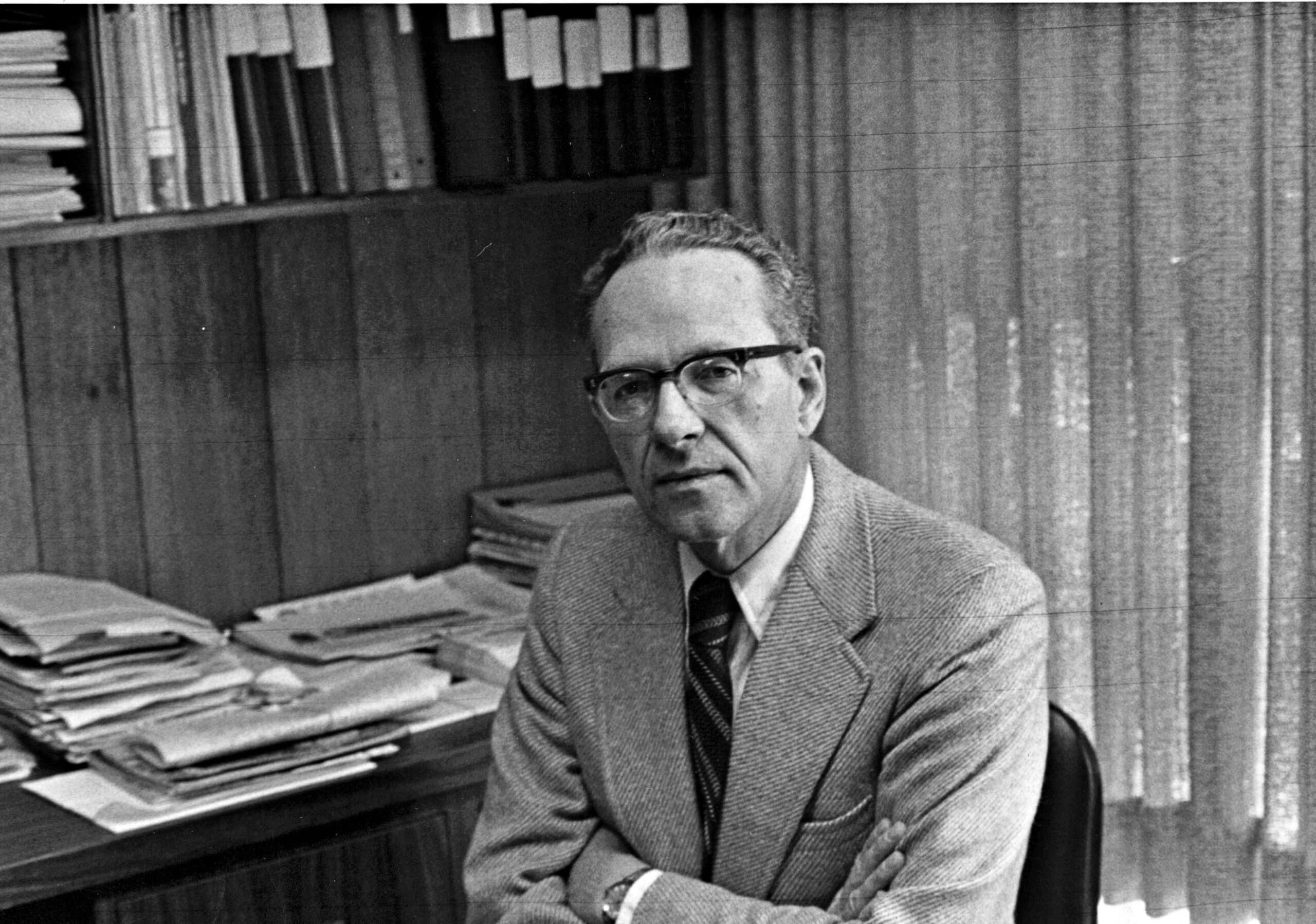
The topic of censorship has been around for decades and is still an issue today. One English professor at the University of Wisconsin Stevens Point, who was also the chairman for the English department, battled censorship for his whole career until his death in 1993. Lee Burress contributed to the fight against censorship with his survey studies, which he wrote about his findings in his essay “How Censorship Affects the School” from 1963, published other books, wrote many articles that were featured in journals such as “The Student Lawyer”, “The Education Digest”, the “ALA Bulletin”, and many others. He was also featured in Wisconsin Public Radio (WPR) in 1983 with Terry Todd. Bear in mind, this article scratches the surface on Burress’ achievements, and it will feature only a handful of his contributions while also describing who he was as a person.
Born on January 28, 1918, Lee Burress had an interesting life and continued with a fighting spirit until he died of cancer at St. Michael’s hospital on March 28, 1993.1 Many faculty and students at UWSP respected him as a professor and for what he did against censorship. While he seemed professional on the outside, and he was, he was also human with many quirks.
Someone, whose name is unknown, came to UWSP to be interviewed for an English professor position and Burress greeted and interviewed them. They said Burress “offered his opinions only tentatively, always waiting to hear what others had to say first”2 and they were “struck immediately by his great and undeserved humility, for it became clear that he was interested in and abreast of things in many fields—including my own specialty of linguistics”.3 During meetings, they mentioned how he would fidget “until he made everyone else uncomfortable, and then he would nod off to sleep in the middle of someone’s monologue”.4 This encounter really showed the readers how humble Burress was despite his scary and professional persona.
Students respected him as well, DeLloyd J. Guth wrote to The Pointer that since they “respected Dr. Lee Burress, [they] found it difficult to believe that [The Pointer’s] reporter, Jeanne Pehoski, accurately quoted him on the subject of ‘history books’ and history teaching (9-11, p. 5)”.5

Burress’ contributions showed how dedicated and passionate he felt about how censorship negatively affected schools and books, and he advocated for the schools and books that were silenced. From 1958 to 1968, Burress was the chairman of the English Department at UWSP and from 1958 to 1988, he was part of the UWSP faculty. During his time at UWSP, he produced an abundance of articles and resources about how censorship worked and what people could do to combat it. “Burress collaborated with the National Council of Teachers of English (NCTE) to design and distribute several surveys aimed at quantifying the impact of censorship and book challenges in Wisconsin and across the nation”,6 and in 1964, Burress published an essay titled “How Censorship Affects the School”. This essay explained the results of a study survey about censorship in schools. As a result, “[c]ensorship is the use of non-professional standards for accepting or rejecting a book”.7
During January 23-24 1965, because of his 1964 essay, Burress went to Washington D.C. to speak at the American Library Association’s annual midwinter meeting to talk about “The Freedom to Read and the School Problem”.8 He also read out a 20 page speech ready with sources to the audience at this event.9
Other contributions in the 1980s include the article he was featured in Censorship: “It’s getting worse in schools,” says Burress (1981)10, his interview about censorship in schools with WPR where he talked with Terry Todd, who was a parent who wanted some books banned at their children’s schools.11 In Censorship: “It’s getting worse in schools,” says Burress, he discussed how “certain parents… [were] organized in efficient and powerful groups” and described them as “censors [who were] well-meaning people, but they’re positive they know things that [weren’t] actually so” and that they “want[ed] to return to a much earlier world when things were simpler and clear-cut”.12


His last battle against it took place in Stevens Point where many schools wanted to ban the book “Anastasia Krupnik” for profanity, and references to underage drinking.13 Burress read the book himself and he wrote a letter to the editor of the Stevens Point Journal to explain how it was a beneficial book for students to read.14 Besides the profanity and references, Burress and many other people stated how the book is about how to handle and understand loss as well as how Anastasia’s family represents a family that’s not “picture perfect”.15 However, the book was ultimately banned in Stevens Point Area Schools.

Lee Allan Burress fought against censorship until he died, and his contributions should be recognized especially with how much effort and devotion he put in fighting against it. As stated before, this is only a very small handful of what Burress contributed to the fight against. Shane Olsen’s post has some more information about other contributions Burress achieved that weren’t stated in this one. When clicked on, the photos will open a new tab where more picture of Burress and his contributions can be viewed.There is so much more material to explore at the University Archives in Room 461 at the Library and Student Resource Center, and you can contact them at archives@uwsp.edu.
- Lee Allan Burress BIO. Vertical File. University Archives. Library and Student Resource Center. University of Wisconsin-Stevens Point. ↩︎
- Lee Allan Burress BIO. Vertical File. ↩︎
- Lee Allan Burress BIO. Vertical File. ↩︎
- Lee Allan Burress BIO. Vertical File. ↩︎
- Guth, DeLloyd J, “Letters,” The Pointer, September 18, 1980.https://epapers.uwsp.edu/pointers/1980/1980Sep18.pdf ↩︎
- Nelson, Nerissa, and Shane Olsen. “Remembering Lee Burress: A Champion against Censorship.” Remembering Lee Burress: A Champion Against Censorship, September 24, 2024. https://uwsplib.blogspot.com/2024/09/remembering-lee-burress-champion.html. ↩︎
- Pg. 3, Burress, Lee A. How Censorship Affects the School : And Other Essays / Lee Burress. Racine, Wis: Wisconsin Council of Teachers of English, 1984. ↩︎
- Lee Allan Burress BIO. Vertical File. ↩︎
- Lee Allan Burress Writings and Censorship Materials, ca. 1960s-1993 and Undated. Collection 34. University Archives. Library and Student Resource Center. University of Wisconsin-Stevens Point. Box 12, Folder 3 – Writings (1 of 9), 1962-1967. ↩︎
- Lee Allan Burress BIO. Vertical File. ↩︎
- Lee Burress, “Censorship”, WPR, 1983 June 8. University Archives. Library and Student Resource Center. University of Wisconsin-Stevens Point. ↩︎
- Lee Allan Burress BIO. Vertical File. ↩︎
- UWSP Archives. Collection 34. Folder 5 – Censorship in Stevens point, “Anastasia Krupnik”. ↩︎
- UWSP Archives. Collection 34. Folder 5 – Censorship in Stevens point, “Anastasia Krupnik”. ↩︎
- UWSP Archives. Collection 34. Folder 5 – Censorship in Stevens point, “Anastasia Krupnik”. ↩︎
Works Cited
Burress, Lee A. How Censorship Affects the School : And Other Essays / Lee Burress. Racine, Wis: Wisconsin Council of Teachers of English, 1984.
Guth, DeLloyd J, “Letters,” The Pointer, September 18, 1980.https://epapers.uwsp.edu/pointers/1980/1980Sep18.pdf
Lee Allan Burress BIO. Vertical File. University Archives. Library and Student Resource Center. University of Wisconsin-Stevens Point.
Lee Allan Burress Photo Name. Vertical File. University Archives. Library and Student Resource Center. University of Wisconsin-Stevens Point.
Lee Allan Burress Writings and Censorship Materials, ca. 1960s-1993 and Undated. Collection 34. University Archives. Library and Student Resource Center. University of Wisconsin-Stevens Point.
Nelson, Nerissa, and Shane Olsen. “Remembering Lee Burress: A Champion against Censorship.” Remembering Lee Burress: A Champion Against Censorship, September 24, 2024. https://uwsplib.blogspot.com/2024/09/remembering-lee-burress-champion.html.
Lee Burress, “Censorship”, WPR, 1983 June 8. University Archives. Library and Student Resource Center. University of Wisconsin-Stevens Point.
Leave a Reply